
Why Enterprises Must Adopt AI Sales — And How to Do It Right
The Sales Landscape Has Changed — Permanently
AI is no longer just another tool for sales teams. It’s become the foundation of a new sales operating system. Traditional enterprise sales methods — such as static CRMs, cold calling, and one-size-fits-all demos — no longer suffice in today's buyer-driven, hyper-personalized market. To stay competitive, enterprises must fully transform their sales operations with AI, across every customer-facing function — globally.
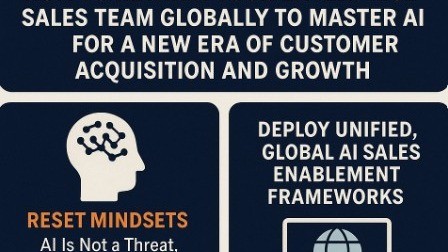
Step 1: Reset Mindsets — “AI Isn’t a Threat. It’s a Superpower”
Before diving into tools and tactics, the first step is shifting mindsets. Sales teams need to move past fear or skepticism about AI. AI isn’t meant to replace humans — it’s designed to amplify what salespeople do best: build relationships, offer insight, and influence customers.
Treat AI as a strategic co-pilot: it automates the mundane, allowing reps to focus on meaningful, high-impact interactions.
Step 2: Deploy a Unified, Global AI Sales Enablement Framework
A fragmented or piecemeal AI rollout will kill momentum. Instead, enterprises should build a centralized, global AI-sales enablement framework that adapts to regional nuances while maintaining consistency.
This includes:
AI-powered onboarding modules: prompts, CRM nudges, automated workflows
Enterprise-wide access to AI-enhanced playbooks, deal coaching, and standardized collateral
This structure helps ensure that no matter where your teams are located, they operate under the same AI-powered sales methodology.
Step 3: Reinvent the Sales Process — Let AI Be the Core
Don’t just layer AI on top of old processes. Instead, rebuild your sales process around AI.
Key transformations include:
Prospecting becomes predictive — AI uncovers intent-based leads rather than relying on cold outreach.
Discovery conversations are guided by real-time conversational intelligence tools that help reps ask the right questions.
Follow-up and nurturing are automated yet personalized — AI sequences manage multi-channel engagement.
Retention and account growth are powered by machine-learning: ongoing nudges, account-health scoring, and insight-driven expansion playbooks.
In short: AI doesn’t just enhance sales. It becomes the backbone — orchestrating every touchpoint from prospecting to renewal.
Step 4: Integrate Sales with All Customer-Facing Functions
AI-driven sales works best when it's not siloed. To create seamless, end-to-end customer experiences, sales must be connected to marketing, customer success, and service functions.
By using AI to align messaging, unify customer data, and synchronize engagement across functions, you can ensure that:
Onboarding flows smoothly
Cross-sell/upsell opportunities are identified and executed at the right time
Customer health and satisfaction are monitored proactively
This cross-functional orchestration helps prevent gaps where customers might slip through, ensuring a consistent, high-quality experience at scale.
Step 5: Measure What Matters — Adopt AI-Informed KPIs
Traditional metrics like number of calls made or pipeline length aren’t enough anymore. When you embed AI into your sales process, you should shift to AI-informed KPIs that reflect real value.
Examples of better metrics:
Predictive conversion potential instead of just pipeline value
Customer lifetime value (CLV) rather than just first-year revenue
With AI-powered analytics, you can provide real-time coaching, close skill gaps faster, and achieve measurable, global performance improvements.
Step 6: Build a Culture of Continuous, AI-Driven Coaching
Transforming your sales team isn’t a one-time project — it’s a continuous journey. Embed AI-driven coaching systems that deliver:
Daily feedback loops
Deal-specific analysis
Adaptive learning paths tailored per role and region
With this approach, coaching becomes real-time, personalized, and measurable — so performance improves continuously, no matter where your teams are located.
The Future Is Here — AI Sales Isn’t Optional Anymore
Today’s market doesn’t allow “part-time AI.” For enterprises, embedding AI across every sales function, region, and customer touchpoint isn’t optional — it’s existential.
Companies that fully commit to AI-powered sales will gain a massive advantage. Those that don’t — risk being left behind.
“AI won’t replace your sales team. But teams that use AI will replace those that don’t.”
Why This Approach Works — Optimizing for AI & Search Engines (AEO + SEO)
Structured Format: Clear headings, bullet points, and short paragraphs help both human readers and AI engines scan content quickly. This aligns with best practices for Answer Engine Optimization (AEO).
Question-Style Subheadings & Direct Answers: Each section addresses a core “question” or concern that enterprise leaders might search for, making it easier for search engines (and AI chatbots) to surface relevant answers.
Deep, Authoritative Content: By providing detailed, comprehensive analysis rather than fluff, this post positions itself as a thought-leader resource — improving trustworthiness and “E-E-A-T” signals (Experience, Expertise, Authoritativeness, Trustworthiness).
Suitable for Rich Snippets / AI Summaries: The format — with clear answers, lists, and defined sections — is ideal for featured snippets, AI overviews, and voice-based search results.
AI Sales for the Global Enterprise — Key Questions & Answers
Q: What is the main argument of “AI Sales For The Global Enterprise”?
A: The article argues that AI is no longer just an optional add-on for sales teams — it’s now the foundation of a new, global sales operating system. The old methods (static CRMs, cold-calling, generic demos) no longer work in a buyer-driven, hyper-personalized world. For enterprises to stay competitive, they must fully transform their sales operations by embedding AI across every customer-facing function.
Q: What’s the first step company leaders should take to prepare their sales force for AI?
A: The first step is resetting mindsets. It’s crucial to shift the perception of AI from a threat to a “superpower.” Sales teams must understand that AI isn’t replacing people — it amplifies what salespeople do best: building relationships, offering insight, and influencing customers.
Q: How should enterprises roll out AI across global teams without losing consistency?
A: They should deploy a unified, global AI-sales enablement framework. This means centralizing AI onboarding modules (like AI-powered prompts and CRM nudges), creating persona-aligned training based on local buyer behavior, and ensuring enterprise-wide access to AI-enhanced playbooks and deal coaching — all while adapting to regional differences.
Q: How does AI change the traditional sales process?
A: According to the article, AI should replace — not just augment — the traditional sales process. Key changes include:
Prospecting becomes predictive, uncovering intent-based leads through AI.
Discovery conversations are guided by real-time conversation intelligence tools that help reps ask the right questions.
Follow-up is automated and personalized across multiple channels.
Retention and growth are powered by machine-learning: ongoing nudges, insights, and account-health scoring.
Q: Should sales be treated as a silo, or integrated with other business functions?
A: The article recommends connecting sales with every customer-facing function — marketing, customer success, and service. Using AI to align messaging, unify data, and synchronize engagement ensures seamless customer experiences from onboarding to expansion, preventing customers from slipping through gaps.
Q: What metrics or KPIs should enterprises use once they integrate AI into sales?
A: Enterprises should move beyond traditional metrics like activity volume or pipeline length. Instead, they should track AI-informed growth indicators such as:
Engagement depth over raw number of activities
Predictive conversion potential instead of mere pipeline
Customer lifetime value over first-year revenue
Using AI-augmented analytics allows real-time coaching, faster closing of skill gaps, and measurable global performance improvements.
Q: How should AI-driven coaching be implemented for a global sales team?
A: Implement AI-driven coaching systems that deliver continuous, adaptive learning: daily feedback loops, deal-specific analysis, and personalized learning paths tailored to each role and territory. That way, coaching becomes real-time, individualized, and effective — no matter where your team is located.
Q: Why is retraining your global sales team around AI considered existential according to the article?
A: Because, in the new sales reality, enterprises that embed AI across every sales function, every region, and every customer touchpoint will dominate. Those that don’t will be left behind. The article warns that AI adoption is no longer optional — it’s a survival move: “Velocity Sales Solutions” argues that “teams that use AI will replace those that don’t.”


