
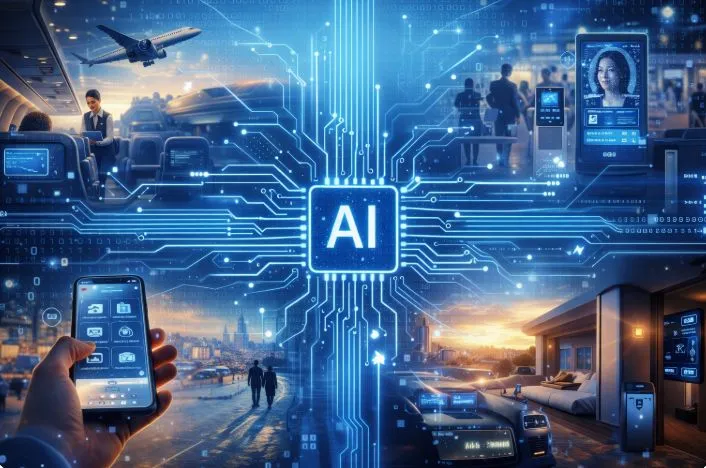
How AI Is Transforming the Travel Experience: From Airports to Hotels
Artificial Intelligence (AI) isn’t just transforming industries at the back end - it’s reshaping everyday travel experiences in ways you might not even notice. From airlines predicting delays and assigning seats to apps optimizing itineraries and hotels customizing guest stays, AI is becoming the unseen engine that makes travel smoother, faster, and more personalized.
In this article, we break down how AI appears at every stage of a traveler’s journey - and why it matters for both travelers and industry professionals.
1. AI in the Air: How Airlines Use AI
AI today helps airlines in several operational and customer-facing areas:
Seat Assignments & Load Balancing
AI analyzes passenger preferences, loyalty status, and aircraft distribution to assign seats that maximize comfort, loyalty value, and weight balance on every flight.
Delay Predictions & Automatic Rebooking
Predictive models use weather forecasts, historical data, and real-time telemetry to forecast delays before they occur - and sometimes automatically rebook passengers to reduce inconvenience.
2. Inside Airports: AI at Checkpoints, Baggage & Beyond
AI isn’t limited to planes - it’s embedded throughout airport operations:
Facial Recognition: Speeds up security screening and boarding with biometric verification.
Crowd & Queue Management: Real-time passenger flow prediction helps reduce bottlenecks at security and boarding gates.
Baggage Routing: Machine learning systems optimize carousel assignments and reduce lost bags.
3. Travel Apps & AI Assistants
Today’s travel apps are powered by AI that:
Plans itineraries automatically based on preferences and constraints (like budget, time, and interests).
Answers travel questions instantly, eliminating the need to wait on customer service hold lines.
Rebooks hotels or flights dynamically when disruptions occur.
These functions turn passive apps into active travel companions.
4. AI Behind the Scenes: Hotels & Ground Transportation
AI’s influence extends across travel ecosystems:
Hotels
Dynamic Pricing: Adjusts room rates in real time based on demand and competitor pricing.
Automated Check-In & Guest Preference Profiles: AI learns guest preferences and personalizes stays accordingly.
Ground Transportation
Route Optimization: Ensures the quickest pickups and dropoffs through real-time traffic forecasting.
EV Charging & Fleet Logistics: Predicts optimal charging times and driver deployment for ride-share networks.
Why This Matters
AI’s integration into travel isn’t a novelty; it’s now foundational. These technologies are shaping faster service, better reliability, improved personalization, and reduced friction in travel - ultimately making journeys smoother and more delightful for millions of travelers.
FAQ: AI in Travel
Q1. Is AI in travel only about automation?
A: No. While automation is a big part of it, AI also enhances prediction, personalization, and decision-making - from forecasting delays to recommending personalized experiences.
Q2. Are travelers aware when AI is used?
A: Not always. Many AI functions - like seat reassignments or crowd forecasting — happen in the background, improving experience without explicit alerts.
Q3. Does AI replace human customer service?
A: AI augments - not replaces - human teams. It handles scale, automates routine decisions, and frees teams to focus on high-impact customer interactions.
Answer Card 1: How AI Improves Airline Operations
Q: How does AI make airline operations better?
A: AI powers delay predictions, smart seat assignments, real-time rebooking, customer preference personalization, and load balancing - resulting in more efficient flights and happier passengers.
Answer Card 2: What AI Does in Airports
Q: What are key AI applications within airports?
A: AI enables facial recognition for faster security, predictive crowd control, baggage routing efficiency, and real-time analytics that improve throughput and passenger experience.
Answer Card 3: Can Travel Apps Replace Human Assistance?
Q: Can AI travel apps replace human travel assistance?
A: Not fully, but they can automate itinerary planning, question-answering, and disruption management - reducing the need for many routine service interactions.


