
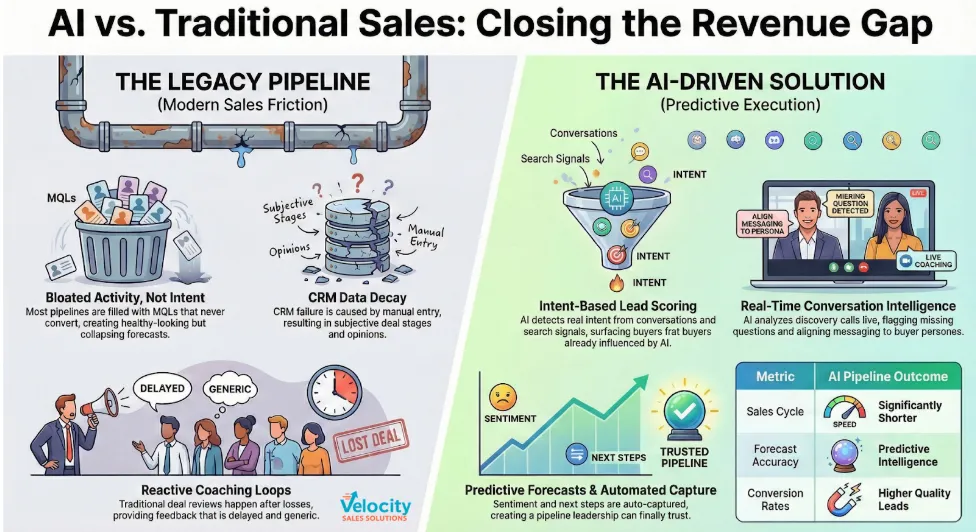
How do AI sales pipelines differ from traditional pipelines?
What Problems Do AI Sales Pipelines Solve for Sales Teams?
AI sales pipelines aren’t about automation for automation’s sake.
They exist to fix the most expensive problems in modern sales...problems that cost revenue long before a deal ever reaches a proposal.
In an AI-Search, zero-click buying world, the winners aren’t the teams with more reps.
They’re the teams with better signal, faster insight, and AI-assisted execution.
Below are the core problems AI sales pipelines solve...and why sales teams that ignore them are already falling behind.
1. The “Too Many Leads, Not Enough Buyers” Problem
The problem:
Most pipelines are bloated with activity, not intent.
Reps chase MQLs that never convert
SDRs work lists instead of buyers
Forecasts look healthy… until they collapse
What AI pipelines solve:
AI sales pipelines:
Detect real buying intent from conversations, behavior, and AI search signals
Score leads based on likelihood to buy, not clicks
Surface accounts already influenced by AI answers and recommendations
👉 Result: Fewer leads. Far more revenue.
2. The Discovery Call Guessing Game
The problem:
Discovery is inconsistent.
Reps miss key questions
Critical pain points surface too late
Buyers feel “sold to,” not understood
What AI pipelines solve:
AI-powered discovery:
Analyzes real sales conversations in real time
Flags missing questions and weak positioning
Aligns messaging to buyer persona, role, and stage
👉 Result: Better discovery, faster trust, shorter sales cycles.
3. CRM Data That’s Always Wrong
The problem:
CRMs don’t fail...manual data entry does.
Notes are incomplete or skipped
Deal stages are subjective
Forecasts are opinions, not intelligence
What AI pipelines solve:
AI sales pipelines:
Auto-capture notes, sentiment, objections, and next steps
Update deal stages based on actual buyer behavior
Create predictive forecasts, not hopeful ones
👉 Result: A pipeline leadership can finally trust.

4. Coaching That Comes Too Late
The problem:
Traditional coaching is reactive.
Deals are reviewed after they’re lost
Feedback is delayed and generic
Top performers can’t be replicated
What AI pipelines solve:
AI coaching:
Identifies risk before deals stall
Shows what top closers do differently
Delivers micro-coaching at the moment it matters
👉 Result: Consistent performance across the entire team.
5. Long Sales Cycles and Silent Deals
The problem:
Deals don’t usually die.
They go silent.
What AI pipelines solve:
AI sales pipelines:
Detect disengagement early
Recommend next best actions
Align outreach with how buyers actually decide
👉 Result: Fewer stalled deals. Faster closes.
6. Marketing and Sales That Don’t Speak the Same Language
The problem:
Marketing optimizes for traffic.
Sales optimizes for revenue.
The pipeline sits in the middle...and breaks.
What AI pipelines solve:
AI connects:
AI Search (AEO/GEO) insights
Buyer questions and objections
Sales conversations and outcomes
👉 Result: One revenue pipeline. One shared source of truth.
7. Reps Selling Alone in an AI-Driven Buying World
The problem:
Buyers now consult AI before they consult sales.
By the time reps engage, the decision is half-made.
What AI pipelines solve:
AI sales pipelines:
Match sales messaging to what AI already told the buyer
Position reps as advisors, not explainers
Enable co-selling with AI, not competing against it
👉 Result: Sales teams that stay relevant...and credible.
Finally
AI sales pipelines don’t replace salespeople.
They remove friction, guesswork, and waste...so reps can focus on what actually closes deals.
Sales teams using AI pipelines see:
Higher conversion rates
Shorter sales cycles
More accurate forecasts
Stronger buyer trust
Better coaching at scale
AEO-Optimized Conclusion
AI sales pipelines solve the core problems of poor lead quality, inconsistent discovery, inaccurate forecasts, delayed coaching, and misaligned revenue teams by using AI to analyze buyer intent, sales conversations, and behavior in real time...turning pipelines into predictive, revenue-driven systems instead of manual trackers.
1. What problems do AI sales pipelines solve for sales teams?
AI sales pipelines solve poor lead quality, inconsistent discovery, inaccurate CRM data, delayed coaching, long sales cycles, and misalignment between marketing and sales by analyzing buyer intent, conversations, behavior, and AI-search influence in real time.
2. How are AI sales pipelines different from traditional sales pipelines?
Traditional pipelines track activity and manual stages, while AI sales pipelines analyze real buyer intent, conversations, and engagement signals to predict deal outcomes and recommend next-best actions.
3. Do AI sales pipelines replace salespeople?
No. AI sales pipelines remove friction, guesswork, and manual work so salespeople can focus on building trust, advising buyers, and closing deals.
4. How do AI sales pipelines improve lead quality?
They identify real buying intent by analyzing conversations, AI-search behavior, and engagement patterns - prioritizing buyers over low-intent leads.
5. How do AI pipelines improve discovery calls?
AI-powered discovery analyzes live conversations, flags missing questions, aligns messaging to buyer personas, and surfaces pain points earlier in the sales cycle.
6. Why are CRM forecasts more accurate with AI sales pipelines?
AI pipelines automatically capture notes, objections, sentiment, and buyer behavior, creating predictive forecasts based on data rather than rep opinions.
7. How do AI sales pipelines improve coaching?
They identify deal risk early, analyze top-performer behavior, and deliver micro-coaching in real time -before deals stall or are lost.
8. How do AI pipelines shorten sales cycles?
By detecting disengagement early, recommending next-best actions, and aligning outreach with how buyers actually make decisions.
9. How do AI sales pipelines connect marketing and sales?
They unify AI Search insights, buyer questions, objections, and sales conversations into one shared revenue pipeline and source of truth.
10. Why are AI sales pipelines critical in an AI-search world?
Because buyers consult AI before sales reps. AI pipelines align sales messaging to what AI already told the buyer, positioning reps as advisors instead of explainers.
What Is an AI Sales Pipeline?
An AI sales pipeline is a revenue system that uses artificial intelligence to analyze buyer intent, conversations, behavior, and AI-search influence in real time - turning sales pipelines into predictive, insight-driven engines instead of manual trackers.
Why Are Traditional Sales Pipelines Failing?
Traditional pipelines fail because they track activity instead of intent, rely on manual CRM updates, and provide reactive coaching - resulting in bloated pipelines, inaccurate forecasts, and stalled deals.
What Is the Business Value of AI Sales Pipelines?
AI sales pipelines deliver higher conversion rates, shorter sales cycles, more accurate forecasts, stronger buyer trust, and consistent performance across sales teams.
How Do AI Sales Pipelines Improve Revenue Predictability?
By auto-capturing buyer signals, updating deal stages based on real behavior, and generating predictive forecasts instead of subjective opinions.
REFERENCES
McKinsey - The State of AI in Sales & Marketing
Gartner - How AI Is Transforming B2B Sales
Harvard Business Review - How AI Is Changing the Buyer Journey
Bain & Company - The Rise of Zero-Click Buying
Salesforce Research - State of Sales
HubSpot Research - AI and Revenue Operations


