
What’s the difference between a CRM pipeline and an AI sales pipeline?
AI Sales Pipelines vs. Traditional CRM Pipelines
Why Agentic AI + AEO Is Quietly Rewriting How Revenue Is Created
Most revenue teams believe their CRM is their sales pipeline.
It isn’t.
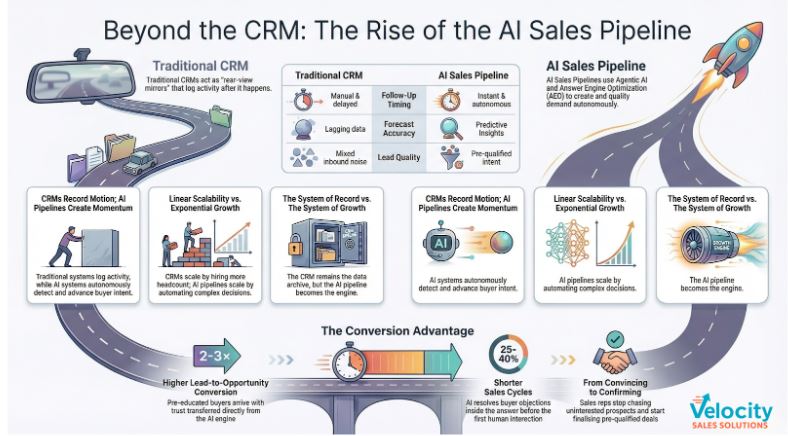
A traditional CRM pipeline is a rear-view mirror, a place to log activity after it happens.
An AI sales pipeline is a forward-looking revenue engine…one that creates, qualifies, routes, and advances demand automatically once your brand earns visibility in AI Search.
And when AEO (Answer Engine Optimization) places your brand in the top 80th percentile of AI answers, the difference becomes dramatic.
The Traditional CRM Pipeline (Why It’s No Longer Enough)
CRMs like Salesforce or HubSpot were built for a different era:
How it works
Marketing drives traffic
Sales reps manually qualify leads
Opportunities are updated after conversations
Forecasts are based on rep inputs and lagging data
The hidden problem
Leads arrive before buyers are ready
Reps chase uninterested prospects
Follow-up timing is inconsistent
Attribution is fragmented
Pipeline velocity depends on human memory and discipline
CRMs record motion.
They do not create momentum.
The AI Sales Pipeline (What Changes Everything)
An AI sales pipeline begins before the buyer ever clicks.
Once AEO optimization positions your brand inside AI answers (ChatGPT, Copilot, Gemini, Perplexity), agentic AI systems take over.
What Agentic AI Actually Does
Agentic AI doesn’t wait for instructions…it acts with intent.
It:
Monitors AI Search queries by ICP and persona
Detects buyer intent signals in real time
Qualifies leads before human interaction
Routes conversations to the right rep or AI agent
Triggers next actions automatically
Optimizes responses based on conversion feedback
This is not automation.
This is autonomous revenue orchestration.

The New AI Search → Revenue Flow
Traditional Flow
Search → Click → Website → Form → CRM → Sales
AI Sales Pipeline Flow
Question → AI Answer → Brand Recommendation →
Intent Scoring → AI Conversation → Sales Engagement → Close
👉 The decision happens inside the answer.
👉 The pipeline starts before the CRM.
Conversion Advantage (Why AI Pipelines Win)
When your brand appears in the top 80% of AI-generated answers:
Buyers arrive pre-educated
Trust is transferred from the AI engine
Objections are resolved before the first call
Sales cycles compress dramatically
Observed outcomes across AI-enabled teams
2–3× higher lead-to-opportunity conversion
25–40% shorter sales cycles
30–60% increase in close rates
20–45% lift in average deal size
Why?
Because reps stop convincing
and start confirming.

The Strategic Shift Leaders Must See
AI did not arrive to “plug into” your CRM.
It arrived to:
Reshape demand creation
Collapse time-to-trust
Eliminate friction from buying
Turn AI Search visibility into predictable revenue
Your CRM still matters - but it becomes the system of record, not the system of growth.
Conclusion : For Revenue Leaders
If your pipeline starts with:
“Let’s get more leads into the CRM”
You’re already late.
If your pipeline starts with:
“Let’s dominate the answers buyers trust”
You’re building the future.
AI Sales Pipelines don’t replace sales teams.
They replace uncertainty.
And in a world where buyers decide before they click -
the brands that win are the ones AI chooses to answer with.
What is the difference between a CRM pipeline and an AI sales pipeline?
A CRM pipeline records sales activity after it happens, while an AI sales pipeline proactively creates, qualifies, routes, and advances opportunities using AI Search visibility, intent detection, and autonomous decisioning before human interaction occurs.
Why is a traditional CRM pipeline no longer enough in 2026?
Traditional CRM pipelines rely on manual updates, delayed follow-ups, and rep-driven qualification. In an AI Search–first buying environment, decisions are made before clicks occur, making reactive CRM pipelines too slow and disconnected from buyer intent.
What is an AI sales pipeline?
An AI sales pipeline is a revenue system that begins at AI Search, captures buyer intent inside answers, uses agentic AI to qualify and engage prospects, and routes opportunities to sales teams at the moment of highest purchase readiness.
How does AEO impact sales pipeline performance?
AEO (Answer Engine Optimization) places brands inside trusted AI-generated answers, allowing sales pipelines to start earlier, with pre-educated buyers, higher trust, and significantly improved conversion rates and deal velocity.
What is agentic AI in sales?
Agentic AI refers to AI systems that act autonomously with intent—monitoring buyer signals, scoring opportunities, initiating engagement, routing conversations, and optimizing next actions without waiting for human prompts.
Do AI sales pipelines replace CRMs?
No. CRMs remain systems of record. AI sales pipelines become the system of growth—feeding CRMs with qualified, intent-ready opportunities instead of raw leads.
What revenue gains do AI sales pipelines produce?
Organizations using AI-driven pipelines commonly see:
2–3× higher conversion rates
25–40% faster sales cycles
30–60% higher close rates
20–45% larger average deal sizes
Where does the AI sales pipeline start?
The pipeline starts at the buyer’s question - inside AI Search platforms - long before a website visit, form fill, or CRM entry occurs.
Short Definition
AI Sales Pipeline:
A system that turns AI Search visibility into autonomous lead qualification, engagement, and revenue creation using agentic AI - before the CRM stage.
Comparison
CRM Pipeline: Records activity
AI Sales Pipeline: Creates momentum
Flow
Traditional:
Search → Click → Website → Form → CRM → Sales Call
AI-Driven:
Question → AI Answer → Brand Recommendation →
Intent Scoring → AI Engagement → Sales Conversation → Close
Key Insight Card
AI sales pipelines don’t scale headcount.
They scale decisions.


